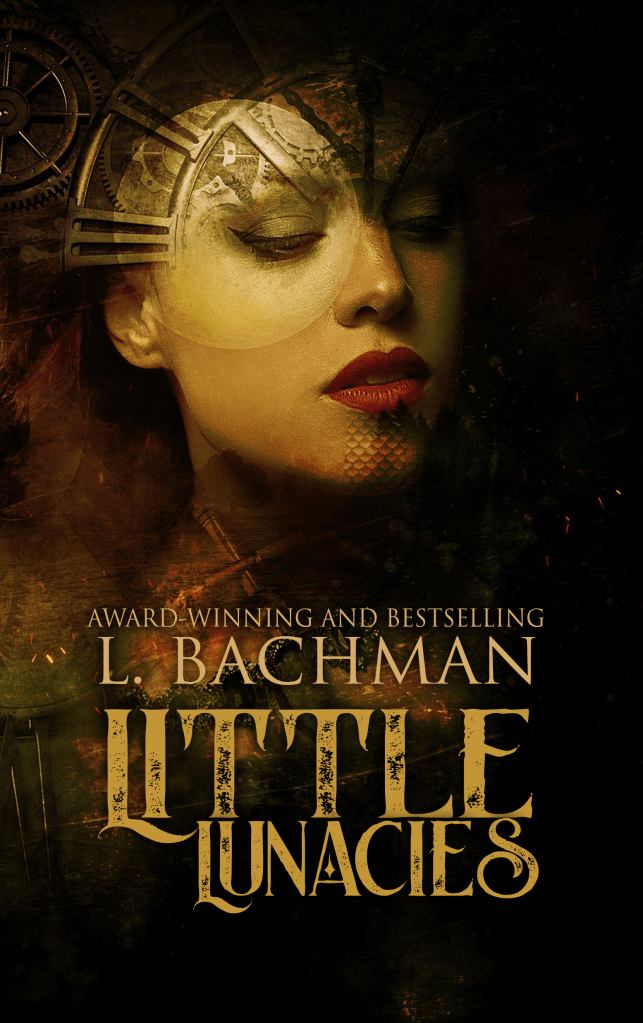
Dark Fiction • Horror • Science Fiction • Psychological • Dark Fantasy
In the immaterial depths lies a layer of darkness. In this absence of light, voices bellow. Crying out their stories and begging for acknowledgment of someone… anyone. For some, they have been given a breath of life over the years, for others they’re just now being released. For the first time, they have been gathered in an ensemble.
These are not quiet stories. They are disturbances—moments where reality bends under emotional pressure and refuses to return to its original shape. Within them, perception fractures, memory distorts, and meaning becomes unstable. A man builds life from grief. A witness cannot tell whether they are alive or observing the dead. A presence watches from the edges of understanding without ever fully revealing itself. And somewhere between horror and revelation, something almost like truth begins to form.
Written by Lynn Lesher under her pen name L. Bachman, the award-winning author invites you into a collection of tales that move across horror, psychological fiction, science fiction, and dark fantasy—each one a self-contained descent into altered reality. These are stories of haunting, not always by ghosts, but by grief, obsession, perception, and the mind itself.
Whether it is a sorrowful lover reaching into the unknown toward a lost connection, a mind constructing meaning where none is stable, or an encounter with forces that refuse explanation, Little Lunacies gathers these fractured narratives into a single space where the strange is treated as intimate, and the impossible is treated as remembered.
This is a collection for those who understand that reality is not always experienced directly—but interpreted, rewritten, and sometimes survived through story.
Inside the Book
Little Lunacies is composed of standalone short fiction across horror, science fiction, psychological suspense, and dark fantasy. Each story is self-contained, yet unified by tone and theme: the collapse or distortion of perceived reality under emotional, psychological, or existential pressure.
Within these pages, readers will encounter worlds that shift without explanation, minds that misinterpret or rebuild reality, and situations where identity, memory, and perception cannot be trusted as fixed.
The collection includes:
• Psychological horror and suspense narratives
• Science fiction grounded in altered perception and speculative concepts
• Dark fantasy stories with mythic or surreal elements
• Fractured, unreliable, or unstable narration
• Explorations of grief, obsession, isolation, and transformation
• Reality distortion and subjective truth structures
• Standalone, self-contained short stories
• Dark atmospheric and emotionally driven fiction
Each story is complete in itself, but leaves behind a residue of uncertainty—what was real, what was imagined, and what the mind constructed to survive it.
About the Work
Little Lunacies is a standalone short fiction collection built around instability—of perception, memory, identity, and reality itself. Rather than adhering to a single genre structure, it moves fluidly between horror, science fiction, psychological narrative, and dark fantasy, using each form as a different lens on distortion.
The work is driven by the idea that reality is not always experienced directly, but interpreted through emotional and psychological filters. In these stories, the mind does not merely witness events—it reshapes them. Horror becomes internal logic breaking down. Science fiction becomes altered cognition rendered as world-building. Fantasy becomes symbolic survival structure.
Each story functions independently, yet collectively they form a pattern of recurring themes: rupture, transformation, loss of certainty, and the search for meaning in unstable environments.
Little Lunacies does not aim to explain its worlds. It aims to immerse the reader in them until certainty itself begins to loosen.
For Readers Who Enjoy
• Psychological horror and existential suspense
• Science fiction with surreal or cognitive distortion elements
• Dark fantasy and mythic reinterpretation of reality
• Unreliable narrators and fragmented storytelling
• Atmospheric, character-driven short fiction
• Reality-bending or perception-shifting narratives
• Ambiguous or open-ended conclusions
• Emotionally driven speculative fiction
• Standalone short story collections with tonal unity
Stories Included
Each story in Little Lunacies is a standalone fracture of perception—moving through horror, psychological distortion, science fiction, and dark fantasy.
Just Underneath
Psychological Horror • Cosmic Horror • Unreliable Narration
After hearing a strange sound beneath the floorboards of his home, a man becomes consumed by the need to uncover its source. What begins as curiosity spirals into a disturbing descent through monstrous visions, infernal landscapes, and fractured perceptions, forcing him to confront the terrifying possibility that the horrors surrounding him may be either something ancient and unknowable—or the unraveling of his own mind.
A Farmhouse Haunting
Psychological Horror • Unreliable Narration • Rural Gothic
A military policeman returns home to find his wife and newborn child dead in the bathroom of their farmhouse, only for their presence to persist in ways that defy logic, decay, and time itself. As grief fractures his perception, he begins recording confessions of escalating violence and disappearance, unsure whether he is protecting a haunting, preserving a memory, or constructing an elaborate delusion to survive unbearable guilt. The house becomes a living witness to contradiction—rooms that refuse to stay consistent, a wife who both knows and doesn’t know she is gone, and a man slowly dissolving into the possibility that love, death, and madness may be indistinguishable when no one else is left to confirm the truth.
The Gaze of Destruction
Psychological Horror • Post-Apocalyptic Gothic • Existential Horror
An immortal vampire rises from a centuries-old grave to find the world reduced to ash, silence, and collapsing memory, where cities have been stripped down to bone and flame and even the air feels like it remembers dying. Moving through the ruins of what once was familiar, he drifts through devastation that erases not only humanity but meaning itself, turning love, history, and identity into scorched fragments he can no longer hold without pain. Haunted by centuries of surviving empires and smaller apocalypses, he confronts a final kind of loneliness—one where survival no longer feels like endurance but punishment. In the wreckage, an angel appears and reframes the devastation as transformation rather than ending, revealing scattered life still clinging to existence and directing him toward a future he does not yet trust but must still walk into, carrying the unbearable memory of everything that burned to make it possible.
The Owls
Psychological Horror • Abduction Mystery • Unreliable Memory Horror
A woman begins to unravel as missing time, unexplained wounds, and a persistent white owl watching her home blur the line between dream, memory, and intrusion, turning her own life into something she can no longer fully trust. Her journal becomes a record of fractures—sleep that behaves like disappearance, light that moves with intent, and sensations of pursuit that linger in her body after waking—while her partner tries to ground her in logic even as every physical detail refuses to cooperate with explanation. As her condition worsens and reality begins to split under stress and fear, the evidence suggests something far more coordinated than illness or paranoia, where memory itself is being altered or erased by an unseen presence that lingers at the edges of perception. By the time she collapses into full disorientation and reemerges changed, the owl is no longer just a symbol but a witness, a signal, and possibly a mask for something watching her far more closely than she ever realized.
Human Ouija
Psychological Horror • Occult Possession • Grief-Driven Supernatural Horror
An award-winning short story, Human Ouija follows a widower adrift in the frozen aftermath of loss who meets a mysterious woman in a cemetery, her quiet rituals of candles, graveside prayer, and inherited spiritual knowledge slowly opening a fragile breach in his grief. What begins as shared mourning and intimate conversation about death, love, and the afterlife deepens into a dangerous pull toward the idea that the dead might still answer if spoken to correctly, and that absence might be reversible through belief alone. Drawn into occult practices and the fragile promise of communication beyond the grave, he turns to a spirit board in desperation, only to discover that what answers him is not his wife, but something that uses longing as a doorway. As his body becomes marked, his perception fractures, and possession takes hold, the story descends into a struggle between identity, grief, and an unseen force that feeds on sorrow until the boundary between the living and the other side collapses entirely.
The Painting of Martel
Psychological Horror • Serial Killer Mythos Horror • Art-Induced Possession
A curious man drawn into the mythology of a notorious serial killer acquires a painting believed to contain hidden clues, coded imagery, and remnants of the murderer’s disturbed genius, only to find his fascination steadily eroding the boundary between observation and influence. As he studies the artwork with increasing obsession, the painted landscape begins to feel responsive, revealing patterns that seem to shift with his attention and dreams that echo the killer’s voice, urging him deeper into interpretation and belief. His roommate watches as his behavior changes—sleep fragments, paranoia deepens, and the painting becomes less an object of study and more a presence that inhabits the room with them both. What begins as intellectual curiosity about art and violence transforms into psychological collapse, as the killer’s legacy refuses to remain contained in pigment and canvas, instead seeping into perception itself until identity, influence, and inheritance blur into a single consuming force that turns admiration into possession and study into continuation.
A Man Named Sowder
Psychological Horror • Unreliable Narration • Reality-Fragmentation Fiction
A fragmented consciousness believes itself to be dead and lingering in a liminal afterlife, observing a man named Sowder who performs clinical, ritual-like work with bodies, while interpreting the sterile environment as a domain of violence, experimentation, and hidden meaning. As awareness deepens, the narrator constructs a role as a “Gatekeeper,” guiding other drifting spirits toward acceptance and imagining hidden doors, judgments, and crossings that shape the logic of this perceived post-mortem world. Memory, identity, and reality blur as the narrator’s perceptions grow increasingly elaborate, attributing intention and cruelty to Sowder while interpreting ordinary procedures through the lens of supernatural horror. The revelation collapses into psychological inversion when the supposed afterlife is exposed as misinterpreted cognition, and Sowder is revealed not as a tormentor but as a caretaker in a medical setting, reframing the narrator’s entire experience as trauma, confusion, and fractured self-awareness rather than death itself.
The Clockwork Children
Dark Fantasy • Mythic Fiction • Existential Horror
A grieving couple, fractured by the stillbirth of the life they once imagined, drift through a home filled with silence, unmet tenderness, and the slow corrosion of shared hope, until the husband—desperate to stitch joy back into his wife’s unraveling mind—begins building mechanical children from discarded clock parts, broken toys, and salvaged sound, unaware that love, when assembled from grief and imitation, can take on a life of its own. What begins as a fragile gesture of healing becomes something stranger and more volatile as the clockwork children awaken in the dark hours, moving with intention, curiosity, and an unsettling devotion that mirrors the emotional wounds of their creators, blurring the boundary between comfort and haunting. As the dolls begin to behave less like objects and more like witnesses to the couple’s unspoken sorrow, the house itself seems to learn their rhythms of pain, until grief is no longer something they carry—but something that learns to walk beside them, breathing softly in wooden steps and stitched silence.
Mishnah: The Immortal Man
Dark Fantasy • Mythic Fiction • Existential Horror
An immortal man, born in the earliest breath of human history, recounts his endless passage through time after accepting an offer of eternal life from a serpent-like intelligence that promised protection, dominion, and the illusion of purpose, only to find himself severed from death, aging, and belonging while watching humanity evolve from fragile tribes into sprawling civilizations that forget their own beginnings. As centuries unfold like collapsing skin, he bears witness to the rise of language, empire, religion, and ruin, carrying within him the memory of a sister whose stories once shaped his understanding of truth and imagination, even as his own myth-making becomes entangled with a deeper, darker voice that teaches him of conquest, survival, and the seductive cruelty of permanence. Haunted by the paradox of endless life, he drifts through eras where he fathers generations he cannot claim and observes the world’s slow self-forgetting, until his identity fractures between witness and origin, myth and man, memory and invention, becoming a living relic mistaken for legend.
Shop
